
Anarchy in the 21st CenturyAnarchocapitalism (AC) is quite the interesting political and economic philosophy that is more plausible than one might initially suspect. It is a subset of anarchist thinking, where our capitalist economic system would extend to all aspects of society, including law, politics, healthcare, and more.
Unlike other anarchist philosophies that optimistically (unless you think AGI isn’t optimistic) hope for a better world without any clear mechanism for how such a society would realistically structure itself without at least some market structure (socialist/communist based anarchy), AC merely proscribes an extension of our market system to all aspects of human interaction.
David Friedman, a renowned legal economist, is perhaps the world’s leading proponent of this anarchist school of thought, espoused thoroughly and articulately in The Machinery of Freedom. As he sees it, the problem with the minarchist position (a libertarian government based on the absolute minimal government possible) compared to full blown anarchy is if you think the government is bad at producing shoes, cars, and pork, then what makes you think it would be good at producing the legal framework in which we trade said goods?
David Friedman described the difference between his more radical position and his father’s, Milton Friedman, the legendary libertarian and Nobel Prize winning economist, as Milton thought AC might work, but probably wouldn’t, while David thought AC might not work, but probably would.*
Here, I will first provide an overview of AC, attempting to defend it against superficial arguments. I won’t address moral arguments for AC from proponents such as Murray Rothbard,** but instead look at consequentialist arguments (due to the “positive” prediction that such a world would look positive). I argue that AC would be neither stable (hence possible) nor libertarian based on Nick Bostrom’s recent paper “The Vulnerable World Hypothesis.”
*From now on, I’ll be referring to David Friedman, unless otherwise stated.
**I agree with Friedman that such moral arguments are not well grounded.
**I agree with Friedman that such moral arguments are not well grounded.


Violence, The Most Obvious Rejection of AC
As surprising as it may sound to the uninformed, Ayn Rand was not nearly the most radical capitalist. In fact, she argued against AC, concluding that a full extension of capitalism would lead to a war of each against all. This school of objectivism therefore requires a minimal amount of government to defend property rights, rule of law, and free markets.
As surprising as it may sound to the uninformed, Ayn Rand was not nearly the most radical capitalist. In fact, she argued against AC, concluding that a full extension of capitalism would lead to a war of each against all. This school of objectivism therefore requires a minimal amount of government to defend property rights, rule of law, and free markets.
Rand couldn’t see a mechanism for solving legal, and especially criminal, matters without centralized government. If I’m bigger than you, then I can bully you into giving me whatever I want. However, as Friedman rightfully points out, even primitive animals exhibit a natural defense of property rights that clearly needs no centralization.
The stable equilibrium is for animals to defend their own territory, even to the point of incurring large costs, but not to attack others unless they have a significant physical advantage. (In many ways, this is the evolutionary basis of loss aversion.) Constant war is simply too costly, although certainly not entirely avoidable.
Since under AC there’s a market for everything, security and insurance firms would evolve to protect you from your neighbor stealing your wife. If you both hire the same neighborhood security contractor SecureMe, they would have an incentive to accurately investigate violations to maintain their reputation and prevent you from joining their biggest competitor SecurityRUs.
What if SecurityRUs and SecureMe have a beef? Since we are talking (in game theoretic terms) of a repeat game, competitors would agree in advance to avoid physical conflict and arbitrate any disputes with the reputable Judge Judy, who is known as being fair and totally not obnoxious.
And, much like Android, iOS, and Windows evolved in a competitive landscape, the invisible hand would create a mesh network of laws, conducive to local customs while general enough to allow international commerce.
What about if you get hit by an uninsured mobster? Every company would have an incentive to pool funds and establish jails. If you can’t afford insurance, hopefully a family member could spot you for a couple of years.
While that may seem like a cut throat society, as an economist, you can’t simply dismiss apriori the negative consequences of the welfare state or the possibility that private charities may get crowded out by government funds.* The AC argues that on net balance such a world would be far preferable by assuming only moderate libertarian beliefs.
Many are rightfully skeptical at this point as to whether or not this system could scale in all situations. The AC would point to ancient Viking societies and our modern privately arbitrated tech patent resolutions as plausible real world alternatives to centralized legal systems, ranging from the size of a village to global corporations.
Additionally, they would point out that our current approach is far from perfect, from racially biased criminal justice systems based on rent seeking prison profiteers to state sanctioned human rights violations. I, for one, am eager to listen to any radical suggestion for prison reform, because our current system destroys lives and generally sucks. Then again, I’m not so sure an entirely free market prison system is moving towards the correct trajectory on this one.
On the other hand, such a hypothetical AC world would likely be libertarian, since I am willing to pay dearly to prevent you from selling me into slavery but not so willing to prevent you from doing bath salts. So, drugs and prostitution would likely be legal, but violent crime would not.
As long as you don’t break into my house to steal my opioids, we’re all good. If not, then I have a right to use a bazooka on your tweeking ass, happily collecting my reimbursement check for a new front wall (assuming a willing underwriter).
As absurd as much of this may sound, private security firms thrive in countries where government enforcement is weak, such as Central and South America and Africa. Personally, I don’t find fault with experimenting in part with decentralized forms of legal structure. What is bitcoin, after all?
Instead, I believe edge cases could prove the downfall of such a system, perhaps where a small group of individuals amass too much power and de facto create a centralized government. Hence, I question the stability of AC over infinite time periods, but for now, let us grant that AC would remain stable by assuming competitive pressures would equalize or at least limit individual power over time.
*In some sense, this is the ultimate antifragile/ skin in the game system, although Nassim Taleb would likely reject it as unstable due to the minority rule.

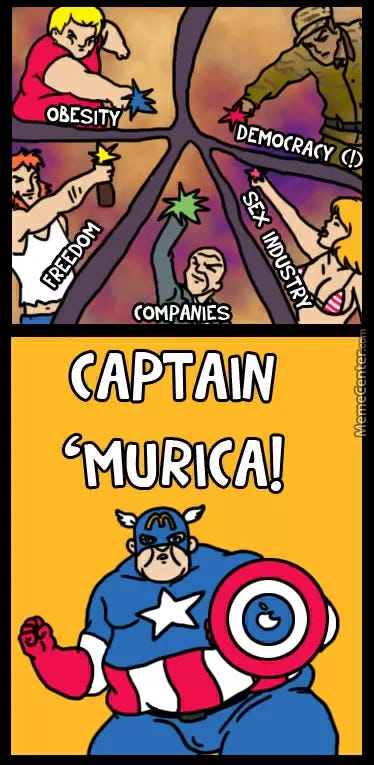
A Flaw in DemocracyIn fact, ACs like Friedman claim a general argument against government. Namely, concentrated interests beat dispersion every time. The Confederation of Copper Coin Companies will lobby to keep the penny as currency, even though each of us individually fucking hates pennies.
At the same time, voters are incompetent, not because they are stupid, but because they have no incentive to spend hours watching political commentary when their vote is insignificant compared to the trillions spent lobbying. While most would argue this is a necessary evil, the AC asks if you would really miss your local sleazy politician who you usually only agree with 60% of the time anyway?
Textbook Microeconomics: Sell the Streets, and Everything ElseWhat does your stereotypical out of touch academic economist say about AC? Well, as long as we assume homogenously exogoneously uniform transitive rational preferences, infinitesimal market size, symmetric information, perfect competition, and no externalities in all markets, no economist would ever object to AC. But while a perfect representation of your classroom economist, this is an unfair caricature of AC.
Libertarians have been arguing for decades that private monopolies and cartels are notoriously difficult to maintain without government intervention/regulation (support). If a company is making extremely high profits, rest assured other big companies would want a piece of the action. I actually have quite a bit of sympathy for this view, as historically, most monopolies are supported by heavy regulation that raises the barriers of entry to potential smaller competitors.*
Open up Xfinity to thousands of local entrepreneurs and their customer service will improve real fast. In the age of network effects (Google, Facebook, Amazon, etc.), however, I leave it to the reader to decide if natural monopolies are as unlikely to thrive as they have been in the past, and whether anti-trust law should correspondingly evolve.
Symmetric information and rational preferences are mathematical constructs that AC need not assume. The AC would point out that you can’t phish for fools in a highly competitive market; or at least, it can’t be worse than our current system. Certainly, pockets of stupidity would thrive, but the system as a whole would be antifragile thanks to skin in the game.
Patents wouldn’t exist, but neither would trolls. Roads could be toll financed, and firefighters would be part of your insurance package. Private philanthropy would thrive thanks to the lack of governmental crowding out. Healthcare would be more affordable without bureaucratic inefficiencies, and the 2008 financial collapse wouldn’t have happened without central bank distortions and politically sanctioned moral hazard in the housing market.
But, in David Chalmer’s words, now comes the hard problem: externalities and military conflicts.
*Not to mention how inaccurately our school history books teach regarding the rise of the railroad, oil, and auto companies.
Free Not To ChooseAn externality occurs when a 3rd party benefits or loses from a transaction you and I engage in. I might be writing this paper for only Nick Bostrom and David Friedman (both of whom will likely never see it), but now you guys all get to benefit! On the other hand, I like cheap meat and oil as much as the next guy which would probably destroy the planet even faster under AC.
Not so fast, says the AC. As Milton Friedman pointed out in Free To Choose, the government itself creates externalities (smoke stacks), the negatives of which far outweigh the positives in the AC’s view. But a military conflict changes the dynamics of this calculation, as even David Friedman admits.
As a classic tragedy of the commons, if a military chooses to protect a certain area, everyone there benefits from the positive spillovers. Yet in an AC society, I am welcome to not join the Defense Forces of Denver. A free lunch. Everyone comes to the same conclusion, hence no one joins the military. And the damn Canadians invade us.
Nothing centralizes power like a military threat, especially a perceived one. Here’s where the fatal flaw in AC lies, in my view.


A Black Ball in the UrnNick Bostrom is one of the most unique philosophers alive today. He’s the kind of guy who would be wearing a tin hat if he was born a century earlier. Bostrom rose to notoriety after popularizing the surprisingly plausible simulation argument (more on that forthcoming) and has backing from the Elon Musks of the world thanks to his alarm bells regarding artificial general intelligence safety.
So when he again comes up with a terrifying and convincing thought experiment that could radically change the entire nature of society, your ears should prick. Bostrom asks us to imagine the horrendous: what if instead of being extremely difficult to procure, produce, and deploy, nuclear bombs could detonate by placing two pieces of glass in some sand and running an electrical current through them? There would be no school shooters; a single lunatic could turn Atlanta into ashes. Let us call such an individual The Joker.
Whoa, whoa, whoa, let’s not just panic, the Steven Pinkers of the world say. There’s no point in thinking like that little Johnny, clearly we know in hindsight that nuclear bombs are very hard to create. And there’s less violence than ever!*
But the point is we can’t and didn’t know that back in World War II. The race to create a nuclear bomb occurred after a couple of physicists ran the math, shat their pants, and, having no clue if it would be easy to make and the Nazis would beat them, spurred the most important scientific undertaking in human history through the Manhattan Project.
If nuclear bombs grew on trees and activated upon exposure to H2O, civilization would halt, likely never again advancing beyond rural communities, quite plausibly operating under AC that no proponent would support. Such a world, in Bostrom’s ever darkly poetic words, would have drawn a black ball from the urn.
*Sorry, I just finished reading Skin in the Game, and Nassim Taleb throws some heavy shade on Steven Pinker.


Bostrom asks us to imagine that every time we develop a new technology, whether its GMOs that create super bugs, a virus with no cure, oil that destroys the planet, or AI that takes over the world and converts our brain into silicon to unify quantum mechanics and general relativity, we are drawing a ball from the technology urn.
Most technologies are white balls, those that will have mostly or entirely positive impacts. Gray balls are technologies that have both positive and negative impacts such as cheap oil. Black balls may or may not exist; these are balls that result in the destruction of any civilization that discovers them. This is usually because the technology is sufficiently destructive and sufficiently easy for a minority of the population to acquire and use against the rest of the population.
Given that by definition no one can possibly prove in advance that black balls do not exist until said technology is discovered/invented, Bostrom conservatively claims that the probability of a black ball existing could be non zero.
Vulnerable World Hypothesis (VHW): P(B exists) > 0
As an economist, I deal in expectations. Even if the P(B exists) == 0, the expectation could (and should) be non zero. Furthermore, self selection is no argument that P(B exists) = 0, since any population (such as our own) is alive until they draw a black ball. Therefore, today’s world exists in the following state:
Vulnerable World Expectation (VHE): E[P(B exists)] > 0
Surely, there must be a way to purchase civilization wide insurance such that E[P(B exists)] = 0. We need to, in fact, since a vulnerable world is in some sense that biggest externality of all. Existential threat is an irreversibility.*
Bostrom argues convincingly that the only way to get E[P(B exists)] = 0 is through terrifyingly Orwellian means. Namely, thanks to the “diverse motivations” of earthly people, we need at least one of the following to occur:
- Restricting Technological Development
- Preference Modification of Extremist Ideology (those willing to use tech simply Joker-style)
- Extremely Effective Preventative Policing
- Effective Global Governance
The first two are likely impossible under all structures, but certainly under AC. The last two sound innocuous until you look under the hood.
*I would argue that E[P(B exists)] > 0 is worse than P(B exists) > 0 because the expectation is what creates the race dynamics that leads to a winner take all scenario at the sacrifice of safety. This could be especially terrifying in a race for AGI, since AGI is simultaneously the solution to global governance and could be the black ball.
2084Let’s assume a black ball is drawn from the urn. Some mad scientist discovers a simple way to DNA sequence a virus without cure using a common 3D printer. She publishes her manifesto via Tor, using VPNs and public key encryption, with detailed instructions on how to recreate. How could we stop others from using it, or, even better, have prevented her from publishing it in the first place? Well, unfortunately, there is simply no way to do this without a global surveillance system.
Something or someone would need to watch what every single person and organization does at all times. Otherwise, a single Joker could reign chaos upon the world. Furthermore, we need global governance, in Bostrom’s words, to protect global commons and to “exit the semi-anarchic default condition.”
I know, I know. You’re begging me to tell you there’s a simple flaw missing in this reasoning. Surely a global surveillance and world order is overkill for a little thought experiment? Unfortunately, I don’t think there’s any other way to eliminate the Vulnerable World Expectation. That’s in today’s world and today’s governmental system. AC has no governmental system.
Anarchocapitalism in a Vulnerable ScenarioTo do some fake math, let’s assume a network interaction between people drawn from the following probability distribution.
Distribution(
Jokers, Steven Pinkers, Physicists, Economists, Philosophers, Evil Corp
)
Jokers, Steven Pinkers, Physicists, Economists, Philosophers, Evil Corp
)
The Steven Pinkers make up at least 95% of the population. These people are not worried at all about existential threat. Everyone else adds up to 5%, at ~1% each. Evil Corp is a misnomer. They really should be called Do Little Evil Corp. In other words, we don’t need to assume nefarious preferences on behalf of Evil Corp; some companies will out of self preservation believe VWE.
Let’s assume we are operating in a world governed by AC. Break up the world into t time intervals, from t0 to tN, where tN is the life of the universe.
At some point in time, tB, the physicists make some potentially black ball urney type discovery like the nuclear bomb. Then, say at tV, where tB≤tV, a Nick Bostrom philosopher type will discover the VWH. This simple discovery will result in VWE, since now many individuals could believe our world to be vulnerable.
In any random world, tV would probably usually be plus or minus a couple of millennia from now, depending on the level of technological sophistication and discoveries (nuclear, nanotechnology, biopharmaceuticals, etc.) of such a society. And to stroke my ego a little, let’s say tVMe is the time period where an economist realizes that the AC society they are living in might be unstable due to VWE. Usually, tVME > tV, since economists like myself are late to this whole “accurately describe reality” game.*
Here’s the kicker. Even if there is a flaw in Bostrom’s thinking (which there probably isn’t, the dude’s a savant), a non trivial portion of the population might begin fearing what would happen if another group of people discovered a black ball in the urn.
I’m certainly not assuming perfect rationality. They would conclude that something must be done. That something and only thing, per Bostrom’s thesis, is a global surveillance system and global government.
The Steven Pinkers of the world become irrelevant, due to the minority rule.** Since we are talking about the ultimate winner takes all situation, suddenly we have an incentive to create the damn thing, since if an opposing group of individuals beats us, the world is doomed.
The physicists blast full steam ahead,*** with some Jokers sprinkled throughout. The economists and philosophers ring the alarm bells. Finally, Evil Corp funds the physicists. Either a Joker wins and there was a black ball in the urn, or Evil Corp succeeds in quashing the future expectation that there is a black ball in the urn by establishing a global surveillance program with global governance.
Winner Take All Scenario
Stability in AC: Either[Joker → P(B exists) == 1, Evil → E[P(B exists)] == 0]
Evil just stands for any company in an AC society, be it OpenAI (Philosophers/Economists), Google (Self Interested), or Huawai (possibly nefarious). Point is there’s no government, so the deepest pockets will likely win.
Deeper point, either a Joker or group of Jokers will destroy the world, otherwise the system is unstable until some company quashes the expectation of a vulnerable world by establishing a world government and surveillance system.
So, back to my original argument that AC would be neither libertarian nor stable, virtually no libertarian would support such a surveillance program. The risk of misuse would be much too high. But in an AC world with no pesky governments, corporation Hooli, led by the egomaniacal yet civic minded Howard Roark, would take it upon itself to establish a world order.
In conclusion, this world would certainly not be libertarian. It could possibly reach stability after removing VWE, but would it conceivably remain AC? Plato’s forms are relevant here. Is a society controlled by a small group of executives running corporation(s) maintaining global surveillance to protect the world order really that different from a centralized government (or our current world for that matter)?
* tVMe = 1939
**I really have nothing against Steven Pinker. I actually like his optimism!
***In WWII, it was the physicists. WWIII might just come down to the computer scientists. AKA Evil Corp = Google and the black ball is AGI 😮
**I really have nothing against Steven Pinker. I actually like his optimism!
***In WWII, it was the physicists. WWIII might just come down to the computer scientists. AKA Evil Corp = Google and the black ball is AGI 😮


